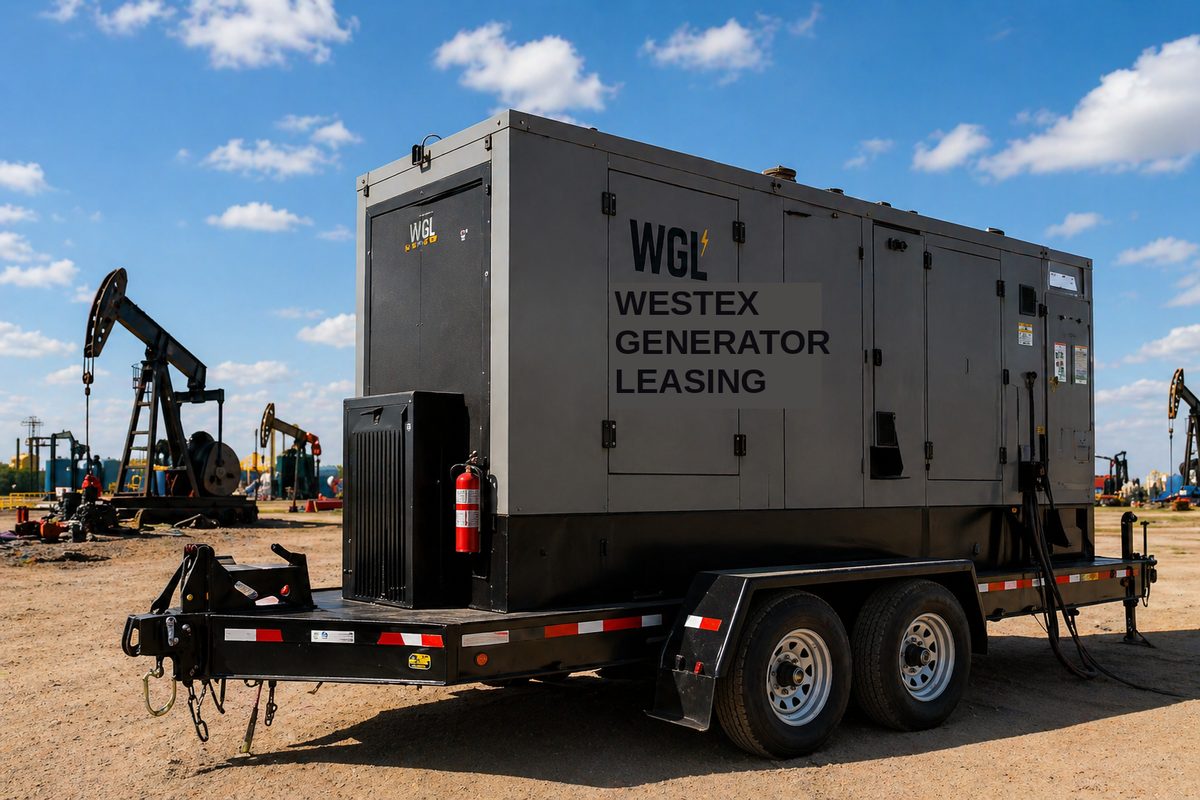
Most drilling and production sites in the Permian Basin can run on a single 400kW generator. But there are situations where one unit is not enough, or where relying on a single unit introduces risk that the operation cannot absorb. That is when operators start looking at paralleling: running two or more generators in synchronized configuration to serve a single electrical load.
Paralleling is not about simply plugging in a second generator next to the first one. It requires synchronization of voltage, frequency, and phase angle between units before they can share a common bus. Done correctly, it provides more power capacity, built-in redundancy, and operational flexibility. Done incorrectly, it damages equipment.
When Paralleling Makes Sense
There are three primary scenarios where operators deploy multiple generators on a single location.
**Scenario 1: The load exceeds a single unit’s capacity.** Some operations, particularly multi-well pad sites, frac operations, or sites running large electric submersible pumps, have power demands that exceed 400kW. Rather than sourcing a single massive generator (which introduces its own logistical and maintenance challenges), operators parallel two or more 400kW units to meet the total load requirement. Two paralleled 400kW generators deliver 800kW of available capacity with the flexibility to scale up or down as the operation evolves.
**Scenario 2: N+1 redundancy.** This is the reliability play. If your site load is 350kW, a single 400kW generator handles it with some headroom. But if that unit goes down for any reason, whether a scheduled PM, a fault, or an unexpected failure, your operation stops. An N+1 configuration places a second generator on standby that can pick up the load immediately if the primary unit trips. For operations where downtime costs thousands of dollars per hour, the cost of a second generator is insurance, not expense.
**Scenario 3: Phased deployment.** Some sites start with a low power requirement during initial drilling and ramp up significantly during completion and production phases. Paralleling allows operators to start with one unit and add a second when the load increases, rather than deploying an oversized unit from day one that runs inefficiently at low load for weeks or months.
How Synchronization Works
Before two generators can share a common electrical bus, four parameters must be matched: voltage magnitude, frequency, phase angle, and phase rotation. Modern generator controllers, like the Basler units on WGL Power’s fleet, handle the synchronization process automatically. The controller monitors the incoming generator’s output against the bus voltage and closes the paralleling breaker only when all four parameters are within tolerance.
The critical point for site supervisors to understand is that manual paralleling without proper synchronization equipment is dangerous. Out-of-phase closure can generate fault currents that damage windings, blow breakers, and create arc flash hazards. This is not a field-expedient operation. It requires the right equipment and the right setup.
On WGL Power units, the customer connection box includes a paralleling interface with indicator lights that confirm synchronization status. The system is designed so that units cannot be connected until they are confirmed in phase.
Load Sharing and Management
Once two generators are paralleled and sharing a common bus, the control system manages load sharing between them. The goal is to distribute the electrical load proportionally so that both units operate at similar loading percentages. This prevents one generator from running at near-capacity while the other idles, which would cause uneven wear and reduced fuel efficiency.
Load sharing is managed through droop control or isochronous control, depending on the application. In most oilfield configurations, droop control is the standard approach: each generator’s governor allows a slight frequency decrease as load increases, and the resulting frequency differential between units naturally balances the load distribution.
For operators, the practical takeaway is that paralleled generators should not be left to free-wheel without proper load sharing controls. The control system does the work, but it needs to be configured correctly at deployment.
Fuel and Maintenance Considerations
Running two generators instead of one obviously doubles the fuel consumption at full load. But the efficiency story is more nuanced than that. Two generators sharing a 500kW load will each run at approximately 63% capacity, which is typically near the peak fuel efficiency curve for most natural gas generator sets. A single oversized unit running at 50% load may actually consume more fuel per kWh than two properly loaded smaller units.
Maintenance intervals are also affected. Running two units at moderate load puts less thermal and mechanical stress on each individual generator compared to running one unit at near-capacity continuously. PM intervals, oil consumption rates, and component wear patterns all improve when generators operate in their optimal loading range.
What This Means for Your Operation
The decision to parallel generators is site-specific. It depends on your load profile, your tolerance for downtime risk, your production timeline, and your budget. For operations where uptime is non-negotiable, N+1 redundancy is the standard approach. For sites with growing power demands, phased paralleling deployment keeps capital deployed efficiently.
WGL Power’s 400kW natural gas fleet is configured for parallel operation. Our units include the synchronization controls, customer connection boxes, and paralleling interfaces needed for multi-unit deployment. And because every lease includes preventive maintenance, service calls, and remote monitoring, adding a second unit does not add operational complexity to your team.
If you are planning a multi-well pad, a high-load production site, or any operation where a single point of power failure is unacceptable, let us talk about the right configuration for your location.
**Contact:** Sales@wglpower.com | 432-316-6961
**Website:** www.wglpower.com